
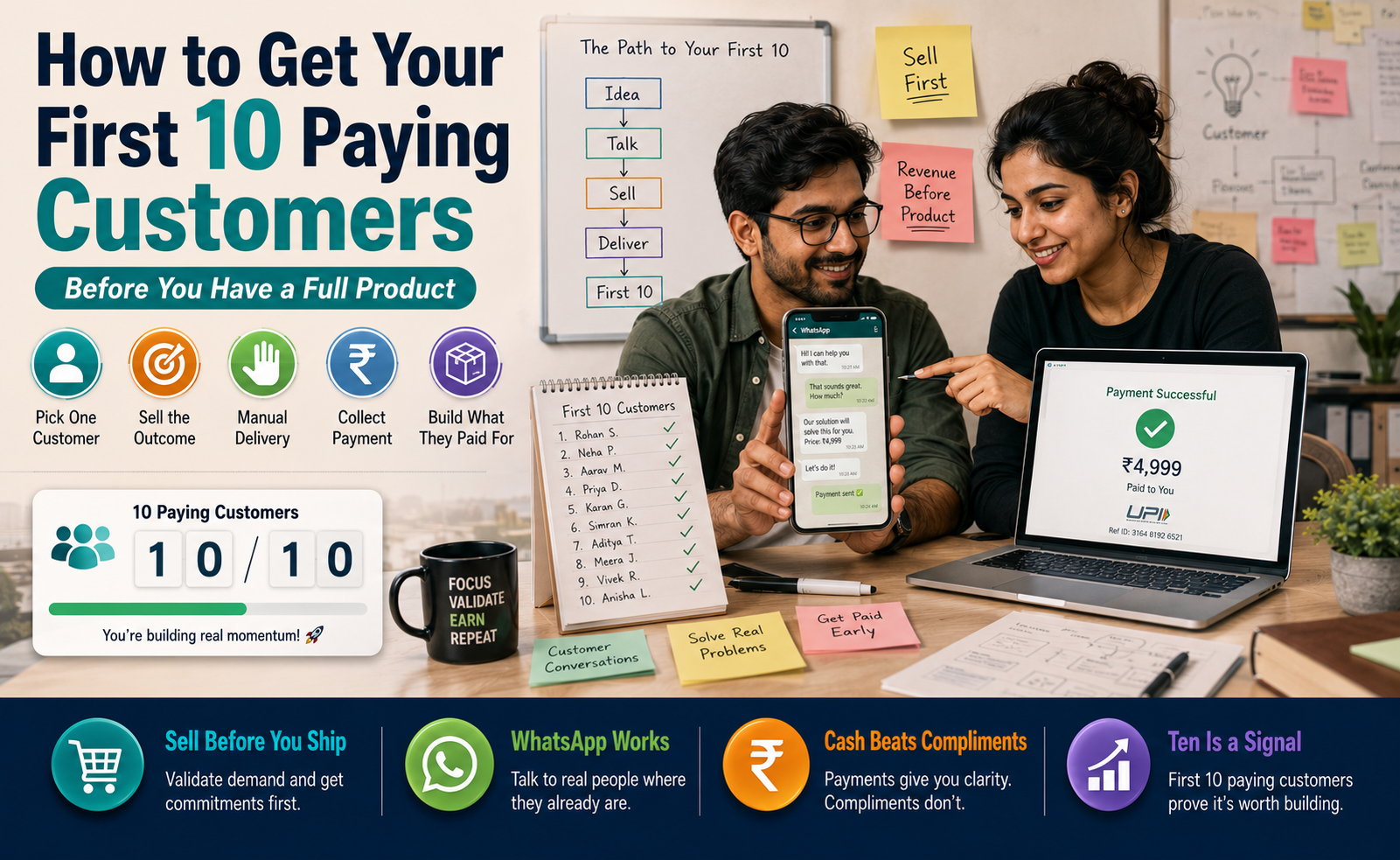
How to Get Your First 10 Paying Customers Before You Have a Full Product
Ten paying customers beats ten thousand free signups. A practical, India-ready playbook for selling before you ship — manual delivery, pre-orders, WhatsApp sales, and the exact steps to go from zero revenue to your first 10 buyers.
You don't have a product yet. Maybe you have a landing page, a Figma prototype, or just a notebook and a problem you can't stop thinking about. And somewhere in the back of your mind, there's a voice saying: "I'll get customers after I launch."
That's the voice that keeps founders broke for six extra months.
Here's the shift that changes everything: your first 10 paying customers are not a reward for finishing the product. They are the proof that the product is worth finishing. Not free signups. Not "interested" WhatsApp replies. Not your cousin saying he'd definitely use it.
Paying customers — people who transfer money, issue a PO, or prepay before your app is polished. This post is a step-by-step playbook for getting those first 10 in India, on a founder's budget, before you have a "full product."
First, Kill the "Launch First, Sell Later" Reflex
Most startup advice follows a broken sequence: idea → build for 6 months → launch → hope people pay. The founders who move faster flip it: idea → find people with the problem → sell the outcome manually → collect payment → build only what paying customers proved they need.
Meesho started with resellers on WhatsApp. Urban Company started with phone calls and operators. Zomato began as a PDF menu directory. The pattern is always the same: revenue before infrastructure. Ten paying customers before a full product isn't a hack — it's how most real businesses begin.
What "Paying Customer" Actually Means
Before you chase ten buyers, define what counts. A paying customer gave you real money (UPI, Razorpay link, invoice) for a specific outcome before your full product exists.
- Counts: prepaid pilot fees, advance for manual delivery, a school paying before your LMS is built
- Doesn't count: friends paying ₹100 to be nice, "we'll buy at launch," free trials that never convert, LOIs with no deposit
Manual delivery still counts as a real sale:
- Prepaid subscription collected over a Google Form
- ₹5,000 advance for a service you deliver by hand for 30 days
- A shop owner paying for a WhatsApp catalog setup you do personally
Ten is the magic number — small enough to do by hand, large enough to prove it's not luck. Three might be a fluke. Ten is a signal.
Step 1: Pick One Customer Type (Not "Everyone")
The fastest way to never get ten paying customers is to sell to everyone. Instead, write one sentence: "I help [specific person] achieve [specific outcome] without [specific pain]."
- "I help coaching institutes collect fees on time without chasing parents on calls."
- "I help D2C brands get product photos live on Instagram within 24 hours."
- "I help small CA firms onboard GST clients without losing documents in WhatsApp threads."
If you can't name the person, you can't find them. List 20 real businesses with this problem — actual names, not categories. If you can't list 20, your target is still too vague.
Step 2: Sell the Outcome, Not the Product
You don't have a full product. Good. Stop selling software. Sell the result your software will eventually deliver.
| What founders say (weak) | What customers buy (strong) |
|---|---|
| "We're building a SaaS tool for inventory" | "We cut your stock mismatch by 40% in 30 days" |
| "It's an AI-powered hiring platform" | "We send you 5 screened candidates in 7 days" |
| "We're making a tutor marketplace app" | "We fill your empty evening batches with paying students" |
Customers prepay for relief — less stress, more revenue, fewer mistakes. Your pitch: "I'm piloting a solution for [outcome]. I'm personally onboarding the first 10 [customer type] at a discounted rate. If I don't deliver [result] in [timeframe], you don't pay the rest." Honesty closes faster than pretending the app is "almost done."
Step 3: Price It Before You're "Ready"
Free users teach you almost nothing about willingness to pay. Price is part of validation. Ask what the problem costs them today, then price your pilot at 10–30% of that cost.
- Pilot fee — ₹2,000–₹25,000 for 30 days depending on customer type
- Razorpay Payment Link — send on WhatsApp after a verbal yes; no website needed
- Advance + balance — 50% upfront, 50% on delivery
- Founding customer rate — limited slots create urgency and justify imperfection
If nobody pays at your price, the pain isn't strong enough, the customer is wrong, or your offer isn't clear. All three are fixable — but only if you actually ask for money.
Step 4: Find Your First 10 Without Ads
Paid ads are for products that already convert. Your first 10 come from direct outreach — unglamorous and effective:
- Your network — personal DMs to people who fit your profile; aim for conversations, not instant yeses
- WhatsApp & LinkedIn — join industry groups, comment on customer posts, follow up with value before pitching
- Go local — visit shops, clinics, institutes in person; one afternoon beats 80 cold emails
- Communities — startup meetups, college incubators, hackathon alumni groups
Don't scale outreach until you've closed 3 paying customers manually. Patterns from the first 3 teach you how to get the next 7.
If your customer is local — shops, clinics, institutes — go there in person. Bring one page: problem, outcome, pilot price, what they get, how to pay. Founders in metros underestimate how much faster trust builds face-to-face.
Step 5: Deliver Manually — The "Concierge MVP"
The concierge MVP means you deliver the outcome by hand using spreadsheets, WhatsApp, phone calls, and Google Forms — while documenting every step for your product roadmap later.
- Marketplace idea → manually match buyer and seller on WhatsApp, take commission
- SaaS dashboard idea → send a weekly PDF report you compile yourself
- Automation tool idea → do the task by hand for 2 weeks, then automate the most repeated step
When they ask "where's the app?" say: "You're in our founding cohort — I'm building around what actually works, not what I guessed. You get a lower price and direct access to me." Most serious buyers respect that more than a buggy v1.
Your customer gets value. You get revenue and a blueprint. Investors call this traction. Your bank account calls it survival.
Step 6: Close the Deal (Script + Objections)
Use this flow on calls and DMs:
- Open: "I'm talking to [customer type] who struggle with [pain]. Is that you?"
- Discover: "How do you handle it today? What does it cost in time or money?"
- Offer: "I'm piloting with 10 [customer type] at ₹[price] to deliver [outcome] in [timeframe]."
- Close: "I have 2 pilot slots left. If I send a payment link today, can we start [day]?"
Common objections — and how to handle them:
- "Send details on email" → push for a 15-minute call instead
- "Come back when it's ready" → that's why the pilot is discounted for early customers
- "Too expensive" → compare to what the problem costs them today
- "Can I try free?" → offer a paid pilot with clear deliverables and refund terms
After you deliver, ask for a testimonial and one referral. In India, customer #7 often comes from customer #2 — B2B sales run on trust chains. Write down every objection after each call; by customer #5, you'll close faster.
A 30-Day Plan: Zero to 10 Paying Customers
| Week | Focus | Target |
|---|---|---|
| Week 1 | Define customer, outcome, and pilot price | 20 outreaches, 8 conversations |
| Week 2 | Sell manually, collect first payments | 3 paying customers |
| Week 3 | Deliver, document process, fix offer | 6 paying customers total |
| Week 4 | Referrals + tighten pitch | 10 paying customers total |
Block 2 hours every morning for sales before building. Five new outreaches per day, one follow-up per day. Founders who sell first hit ten faster than those who build first and sell on weekends.
What to Build After Customer #1
Once money hits your account, resist coding everything. Build only what replaces manual work you've done 10+ times — automate the WhatsApp-to-Sheets copy, template the weekly report, productize the matching flow. Skip admin dashboards, trendy AI features, and mobile apps nobody asked for.
Your first 10 customers are your product managers. They paid with money, not opinions. Build their workflow, not your roadmap fantasy.
How This Connects to TSIH's 30-Day Sprint
Programs like TSIH India exist for founders stuck between selling and building — a 30-day Ahmedabad residency with a dedicated developer, mentors, and infrastructure, 0% equity, and pay-only-after-revenue terms.
The founders who win Demo Day aren't the ones with the prettiest UI. They're the ones with real traction — prepaid customers, revenue, LOIs. Getting your first 10 paying customers before the full product isn't separate from the hub journey. It's the proof that your 30-day build is worth building.
If you can sell it manually, you can sell it when it's automated. If you can't, no amount of cloud credits will save you.
The Bottom Line
You don't need a full product to get your first 10 paying customers. You need one specific customer, one clear outcome, a price that hurts a little to say out loud, and the courage to deliver manually before you automate.
- Don't build in private for months — show something, sell something
- Don't price at zero — free users teach you nothing about demand
- Don't target "everyone in India" — name 20 real businesses
- Don't confuse "sounds interesting" with a sale
- Don't quit after 15 nos — B2B often needs 80–150 outreaches for ten customers
Ten paying customers changes how you build, how you pitch, and how you feel about your idea. It's no longer a fantasy in your Notes app. It's a business with receipts.
One message. One conversation. One payment link. Start today — not after you finish the landing page.
Working on your first 10 customers before Cohort 1? TSIH is built for founders who want to go from idea to MVP — with dev support, mentors, and zero equity.