
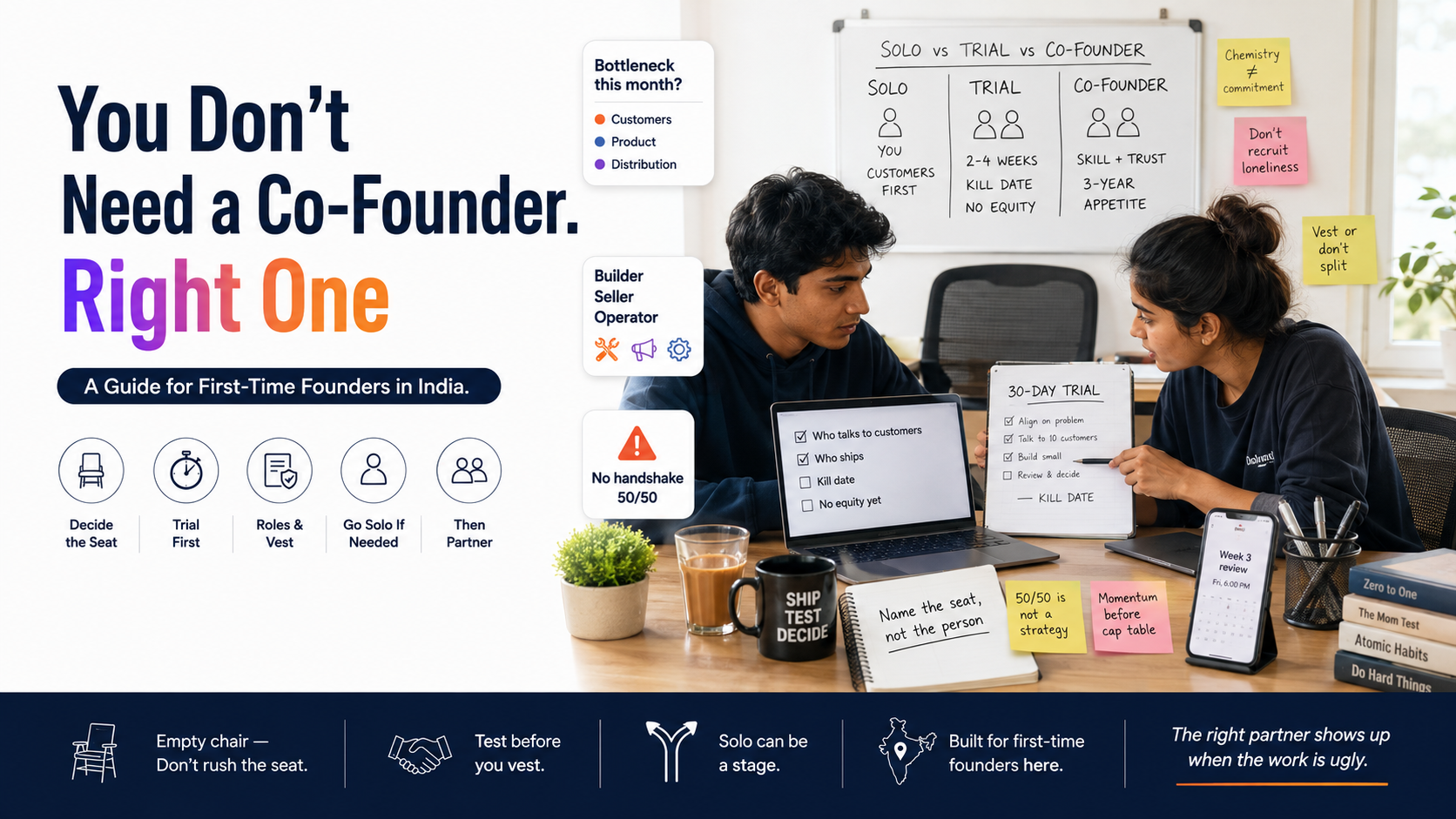
You Don’t Need a Co-Founder. You Need the Right One — A Guide for First-Time Founders in India
Most first-time founders either wait forever for a “technical co-founder” or split equity with a college friend in week one. Here’s how to decide if you even need a partner, who actually fits, how to test the relationship before you sign anything, and when going solo is the smarter first move.
You Don’t Need a Co-Founder. You Need the Right One.
Every founder hears the same advice.
Find a technical co-founder first.
It sounds logical. Investors like teams. Startup stories often feature two or three founders. LinkedIn is full of people announcing “Excited to build with my co-founder.”
So many first-time founders wait.
They keep their startup idea inside a notebook, hoping the “right person” appears one day. They pitch college friends, message random developers, or delay launching until someone says yes.
Weeks become months.
The idea never ships.
Here's what most startup advice misses: a co-founder is not a requirement for starting a company. A co-founder is one of the biggest long-term decisions you'll ever make.
The wrong partner can slow your startup, create conflicts over equity, and even end the company before customers arrive.
The right partner can multiply momentum, share responsibility, and help build something much bigger than either founder could build alone.
This guide helps first-time founders in India understand when to look for a co-founder, how to choose one, what red flags to avoid, and when staying solo is actually the better move.
The Biggest Myth: Every Startup Needs a Technical Co-Founder
One of the biggest misconceptions in India's startup ecosystem is that every startup needs a technical co-founder from Day One.
It doesn't.
A technical founder is valuable when technology is your biggest bottleneck.
But many early-stage startups don't fail because of missing technology.
They fail because nobody talks to customers.
Nobody validates demand.
Nobody sells.
A founder who understands customers and ships manually often moves faster than a technical founder building features nobody requested.
Before searching for a technical partner, ask yourself one question:
What is stopping this startup from moving forward this month?
If the answer is customer conversations, marketing, sales, or operations, then adding another engineer won't solve the real problem.
A co-founder should solve your biggest constraint—not become your startup's decoration.
What a Co-Founder Actually Means
A co-founder is much more than someone who writes code or helps on weekends.
A true co-founder shares:
- Long-term ownership.
- Risk.
- Decision-making.
- Responsibility.
- Commitment for years—not weeks.
A co-founder is not:
- A freelancer.
- An intern.
- A friend helping after college.
- Someone joining because they're currently free.
Before giving someone equity, understand the difference between chemistry and commitment.
Chemistry means conversations are easy.
Commitment means they still show up when customers complain, deadlines slip, or life becomes difficult.
Startups survive commitment—not excitement.
Step 1: Decide If You Actually Need a Co-Founder
Don't search for people.
Search for problems first.
Write down exactly what needs to happen over the next 90 days.
Ask yourself:
- Can I deliver Version 1 without a co-founder? If yes, start.
- Is my bottleneck skill, time, credibility, or loneliness? Each bottleneck needs a different solution.
Many founders confuse loneliness with needing a co-founder.
They're completely different problems.
Communities, residencies, hackathons, and founder groups solve loneliness.
Equity should solve business bottlenecks.
Step 2: Define the Role Before the Person
Don't begin with:
I need a co-founder.
Start with:
The company needs someone who owns this outcome every week.
Examples of a clearly defined seat:
- Build the MVP.
- Close five B2B pilots.
- Manage operations and fulfilment.
- Lead product design and user research.
Bad definitions look like:
- Hustler.
- Technical person.
- Startup enthusiast.
- Growth guy.
Those aren't responsibilities.
Those are personality labels.
Define Outputs Instead of Titles
| Seat | What they own every week | Weak label |
|---|---|---|
| Builder | A working wedge in users’ hands | “Technical person” |
| Seller | Conversations, pilots, payment links | “Hustler” |
| Operator | Delivery, support, messy WhatsApp reality | “We’ll figure ops later” |
| Domain | Access and trust in a specific industry | “Advisor with a title” |
A startup rarely needs four co-founders.
Usually it needs one complementary founder and specialists later.
Step 3: Where Should You Find a Co-Founder in India?
The internet says:
Looking for a CTO. Billion-dollar idea.
Those posts rarely attract the right people.
Instead, work with people before discussing equity.
Better Places to Meet Potential Co-Founders
- Startup hackathons.
- Founder residencies.
- College innovation labs.
- Open-source communities.
- Startup meetups.
- Builder communities.
- Product design sprints.
Shared work reveals far more than shared conversations.
Build Together Before You Build a Company
A weekend prototype teaches more than ten coffee meetings.
Someone who solves problems under pressure is much easier to trust than someone who simply sounds excited.
Step 4: Test Before You Vest
Never give equity before working together.
Run a 2–4 week founder trial.
A Simple Founder Trial Framework
- One customer-facing outcome in 2–4 weeks (pilot, landing page plus manual delivery, or a working wedge).
- Clear split of work in a shared doc: who talks to users, who ships, who follows up.
- A weekly ritual that is boring on purpose: 45 minutes, same day, numbers not vibes.
- A kill date. If either person is half-in when the trial ends, you walk as colleagues — not as enemies with a half-registered company.
Watch These Signals During the Trial
Positive signals:
- Takes ownership without reminders.
- Talks to customers.
- Finishes work.
- Accepts feedback.
- Solves problems calmly.
Warning signs:
- Changes priorities every day.
- Wants recognition before results.
- Avoids uncomfortable conversations.
- Stops responding during stressful weeks.
- Blames others for missed work.
Founders don't need perfect agreement.
They need healthy disagreement.
Step 5: Talk About Equity Before It Becomes Emotional
Many Indian startups split equity like this:
We're friends. Fifty-fifty.
It feels fair.
Often it isn't.
Equity reflects future commitment—not friendship.
Conversations Every Founding Team Must Have
- Who owns Product?
- Who owns Sales?
- Who owns Operations?
- How many hours per week is each founder committing?
- Who pays startup expenses initially?
- What happens if someone leaves?
A Better Equity Conversation
| Situation | Conversation to have |
|---|---|
| One person brought the idea; both will work full-time | The idea is not 50% by itself. Weight ongoing work. |
| One is part-time for 6 months | Smaller stake and vesting, or advisor/contractor first. |
| One only “advises” | Salary or small options later — not co-founder. |
| You haven’t shipped anything together | No equity yet. Trial first. |
Why Vesting Matters
Vesting protects everyone.
A common startup structure is:
- Four-year vesting.
- One-year cliff.
If someone leaves early, they don't permanently own a large part of the company without contributing long term.
It's one of the healthiest founder conversations you can have.
When Staying Solo Is Actually Smarter
Going solo isn't failure.
Sometimes it's faster.
Stay solo if:
- You can manually deliver Version 1.
- Customers matter more than technology today.
- You're still validating the idea.
- Every co-founder conversation feels forced.
- You're moving consistently every week.
A solo founder can always bring someone in later.
Giving away equity too early is much harder to reverse.
Remember:
Customers don't buy your cap table.
They buy your solution.
Founder Red Flags You Should Never Ignore
Every founder eventually meets someone who feels perfect.
Slow down.
Common Red Flags
- Wants 40–50% equity before shipping anything.
- Doesn't want to talk to customers.
- Only wants strategy meetings.
- Loves startup titles.
- Constantly changes ideas.
- Avoids accountability.
- Says “We'll figure it out later” for difficult topics.
Green Flags Worth Looking For
- Ships work consistently.
- Communicates clearly.
- Handles criticism well.
- Solves customer problems.
- Cares about outcomes more than titles.
Startups become stressful.
Character becomes visible under stress.
A Practical Founder Decision Framework
Before adding anyone to your company, answer these questions.
- Can I get a paying signal in 14 days without a partner? If yes, do that first. Partners join proof.
- Is the missing seat specific enough to hire or sprint? If yes, try scoped help before equity.
- Have we shipped something ugly together under a deadline? If no, you are not co-founders yet.
- Can we talk about vest, time, and who decides — without collapsing? If no, do not incorporate.
- Am I recruiting because I’m lonely or scared? If yes, join a room of founders. Don’t give away the company for company.
Write these answers down.
Choose one path for the next 30 days:
- Solo execution.
- Founder trial.
- Build sprint.
Avoid trying all three simultaneously.
Where TSIH Fits Into This Journey
TSIH is designed for founders who are still figuring out the team.
Instead of asking founders to give away equity early, TSIH focuses on helping teams build first.
Inside the residency founders get:
- Dedicated MVP sprint support.
- Experienced startup mentors.
- Customer validation guidance.
- Product and GTM feedback.
- Founder community.
- Demo Day preparation.
Many founders enter solo.
Some leave with clarity that they genuinely need a co-founder.
Others realise they simply needed focused execution support.
The goal isn't to create co-founders.
The goal is to create momentum.
The Bottom Line
You don't need a co-founder to become a founder.
You need clarity.
Don't wait months for the mythical technical partner while your startup stays inside a notebook.
Don't give away half your company because someone knows React.
Don't confuse friendship with founder compatibility.
Start building.
Talk to customers.
Test relationships before signing equity.
The strongest founding teams aren't the ones that announced themselves first—they're the ones that survived real work together before calling themselves co-founders.
Quick Reference: Solo, Trial, or Co-Founder?
| If this is true | Do this |
|---|---|
| You can sell or deliver a manual v1 | Stay solo. Get 10 conversations or first payments. |
| You need a builder for 30 days, not 5 years | Sprint / scoped help / residency — not 40% equity. |
| You’ve never shipped under stress together | 2–4 week trial with a kill date. No cap table yet. |
| Complementary skill + trust + same 3-year appetite | Co-founder conversation: roles, time, vest, money, tie-break. |
| You’re lonely or want it to “look like a startup” | Community first. Equity last. |
Ready to Build Before You Build a Team?
TSIH helps first-time founders validate ideas, build MVPs, and test real startup momentum before making long-term equity decisions.
Build your MVP. Validate customers. Find clarity before finding a co-founder.