
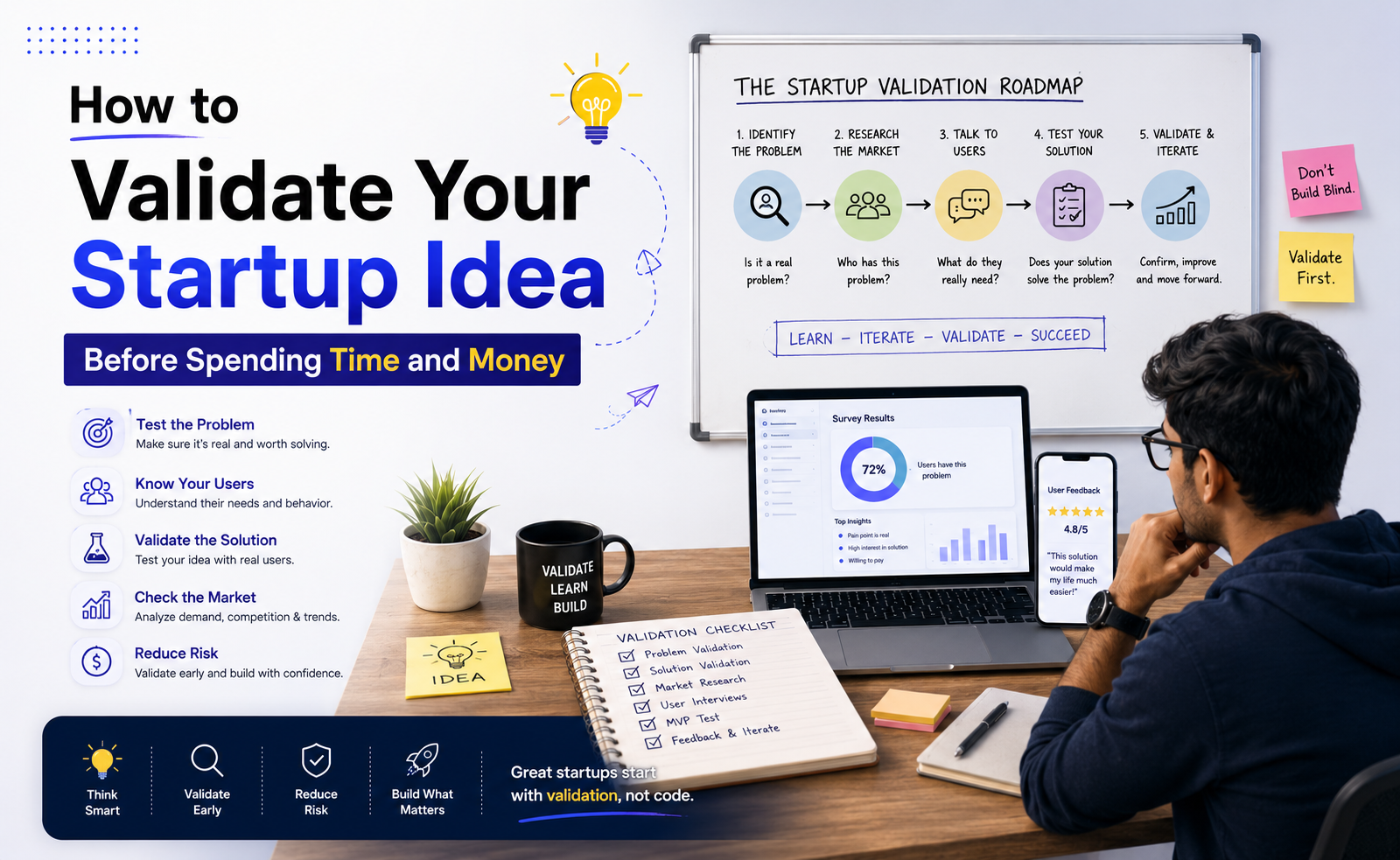
How to Validate Your Startup Idea Before Spending Time and Money
What validation actually means, how to do it on a student's budget, and how Zappos and Dropbox proved the smartest founders validate first and build second.
Every founder remembers the moment their idea felt unstoppable. You've sketched the app on a napkin, pictured the funding round, maybe even thought of a name for the team Slack. And right there, in that excitement, is where most startups quietly start dying.
Not because the idea is bad. Because nobody checked if it was true.
Validation isn't a buzzword you sprinkle into a pitch deck. It's the boring, slightly uncomfortable habit of testing your assumptions with real people before you write a single line of production code or sign a single lease. It's cheaper than failure, and it's a lot less embarrassing than telling your co-founder, eighteen months in, that you built something nobody wanted.
This post walks through what validation actually means, how to do it on a student's budget, and two real startup stories — Zappos and Dropbox — that prove the smartest founders validate first and build second.
What "Validating an Idea" Actually Means
Validation is the process of testing whether people will genuinely use — and pay for — your idea, using the smallest, cheapest, fastest experiment possible.
Notice what it isn't:
- It isn't asking your friends "would you use this?" (they'll say yes to be nice)
- It isn't a survey with leading questions
- It isn't building the full product and hoping
Real validation puts a stranger in front of a real choice — sign up, pay, click, commit — and watches what they actually do, not what they say they'd do.
There's a simple gap every founder needs to respect: the gap between interest and intent. Someone saying "that's a cool idea" is interest. Someone giving you their email, their credit card, or an hour of their time is intent. Only intent tells you anything useful.
Step 1: Write Down the Riskiest Assumption
Every startup idea is really a stack of assumptions. Before you validate anything, find the one assumption that, if wrong, kills the whole business.
Ask yourself: "What has to be true for this to work?" Then rank those answers by how unsure you are and how much it would hurt if you were wrong. That's your riskiest assumption — and it's the only thing worth testing first.
For example, if you're building a subscription box for left-handed school supplies, your riskiest assumption probably isn't "can we source the products" — it's "will enough parents pay monthly for this versus buying once a year." Test that, not the logistics.
Step 2: Talk to Real People (Properly)
Customer interviews are the cheapest research tool a founder has, and most people do them badly. The fix is one rule: ask about the past, not the future.
Don't ask, "Would you use an app that does X?" People are wired to be polite, and they're terrible at predicting their own future behavior.
Instead ask:
- "Walk me through the last time you ran into this problem."
- "What did you do about it?"
- "What did that cost you — in money, time, or frustration?"
- "What have you already tried to fix it?"
If someone struggles to recall a recent, specific instance of the problem, that's a signal the problem isn't painful enough for them to pay to solve. Aim for at least 10–15 conversations with people who actually match your target customer — not family, not classmates doing you a favor.
Step 3: Build the Smallest Possible Test (the MVP, but smaller)
Most people think "MVP" means a stripped-down version of the product. Often, it doesn't need to be a product at all. It just needs to create a real decision point for a real customer.
Common low-cost validation formats:
- A landing page describing the product with a "Join the waitlist" or "Pre-order" button — then you run a small amount of traffic to it and measure how many people actually sign up.
- A concierge or "Wizard of Oz" test — you manually deliver the service behind the scenes while the customer experiences something that looks automated.
- A demo video showing the product working, even if the back end is held together with duct tape.
- A pre-sale — literally asking people to pay before the thing fully exists.
The goal of every version above is the same: get a real signal (money, an email, a booked call) using the least amount of build time possible.
Step 4: Set a Number Before You Start
This is the step founders skip, and it's the one that saves you from fooling yourself. Before you run any test, decide what result would mean "this idea has legs" and what result would mean "go back to the drawing board."
If you don't set the bar in advance, you'll unconsciously move it after you see the results — that's a well-documented human bias, and founders are not immune to it. "We got 40 sign-ups" feels like a win if you expected 20, and a disaster if you expected 500. Decide the number first.
Real Example #1: Zappos Sold Shoes It Didn't Own
In 1999, Nick Swinmurn wanted to start an online shoe store, but he had a problem: buying inventory for an e-commerce shoe business is brutally expensive, with countless sizes and styles, and no guarantee customers would even buy shoes without trying them on first. At the time, the dominant belief was that footwear had to be experienced physically, so e-commerce might work for books and CDs but never for shoes.
Rather than raising money to build warehouses and buy stock, Swinmurn ran the cheapest possible test of his core assumption: would people actually buy shoes online? He approached a local shoe store, asked permission to photograph their inventory, and posted those photos on a simple website he initially called Shoesite.com.
Here's the part that makes it a true validation story and not just a website launch: he told the store directly that he'd take pictures, post them, and if people bought them, he'd purchase the shoes from the store at full price. When an order came in, Nick personally drove to the store, bought that exact pair, and shipped it to the customer — and the customer had no idea the "store" had no inventory at all.
He was losing money on every single sale. But that was never the point. The goal was only to find out whether people would actually buy shoes online, and the test answered that question clearly. Only after Swinmurn had real proof — actual strangers handing over real money — did he raise funding, bring on Tony Hsieh as an investor and eventual CEO, and build the inventory, warehouses, and customer-service culture that Zappos became famous for. Amazon eventually acquired Zappos for $1.2 billion in 2009.
The lesson for a student founder: you don't need a warehouse, an app, or a manufacturing deal to test demand. You need one believable storefront and the willingness to fulfil the first few orders by hand, even if it costs you money to do it.
Real Example #2: Dropbox Validated With a Video, Not a Product
Drew Houston's frustration was personal — he kept forgetting his USB drive and losing access to files he needed. He started building a syncing tool, but the prototype was rough, buggy, and far from something he could put in front of the public.
Instead of waiting until the product was polished, Houston tested demand with a different kind of MVP entirely: a short screen-recorded video showing the product working as if it were finished. He posted the explainer video to Hacker News on April 5, 2007, as part of his application to Y Combinator, with a simple sign-up form for the beta waitlist at the bottom.
The results settled the question of demand almost instantly. Before the video, Dropbox's beta waitlist sat around 5,000 people, and the team hoped the video might push it to maybe 15,000 — instead, the waitlist jumped to 75,000 signups overnight, with no paid advertising and no influencer push behind it. The video also hit the number one spot on Hacker News for two days, which Houston later credited as part of how Dropbox got noticed by Y Combinator's founders and accepted into the program.
What's easy to miss in the retelling is how unfinished the actual product was at that point. It only worked on Windows, hadn't been ported to Mac yet, and could probably not have handled more than a few dozen simultaneous users — none of that mattered for the purpose of the test. The video wasn't there to impress; it was there to answer one question: does this problem matter enough to strangers that they'll hand over their email address for a tool that doesn't fully exist yet? The answer came back loud and clear, and only then did the team pour serious engineering effort into scaling the real product.
The lesson for a student founder: if your idea is genuinely useful, you often don't need to build it to prove that. You need to show it working — convincingly enough — to the right small audience, and watch whether they raise their hand.
What Both Stories Have in Common
Strip away the shoes and the file-syncing, and Zappos and Dropbox ran the exact same experiment:
- They identified the one assumption that mattered most (will people buy shoes online / will people care enough to switch their file workflow).
- They built the cheapest possible version of an answer (a fake storefront / a video).
- They measured a real action, not an opinion (an actual purchase / an actual sign-up).
- They only invested in scaling after the signal was unmistakable.
Neither founder asked his friends if the idea was good. Neither spent the first year building the "real" infrastructure. Both let strangers vote with something real — money or a sign-up — before committing serious time or capital.
A Simple Validation Checklist You Can Use This Week
If you're a student or first-time founder sitting on an idea right now, here's a sequence you can realistically run in 7–14 days:
- Write your riskiest assumption in one sentence.
- Talk to 10 real potential customers using past-tense questions, not future-tense ones.
- Build one cheap test — a one-page website, a video, or a manual "concierge" version of the service.
- Decide your success number before you launch the test — for example, "20 people pre-order at $10" or "5% of visitors join the waitlist."
- Run the test for a fixed window, then look at the actual numbers, not the nicest comments.
- Make a real decision: build, pivot, or stop. All three are valid outcomes — "stop" just saved you six months.
The Real Point of Validation
Validation won't tell you that your idea is guaranteed to succeed. Nothing can promise that. What it does is replace guessing with evidence, cheaply, before you've spent your savings, your semester, or your sanity on something the market never wanted.
Zappos didn't start as a billion-dollar logistics company. Dropbox didn't start as a polished cross-platform app. Both started as small, slightly scrappy tests of a single question. That's the part worth copying — not the shoes, not the video, but the discipline of testing before building.
If you're sitting on an idea right now, you don't need permission, funding, or a finished product to find out if it matters. You need one honest test and the willingness to listen to what it tells you.