
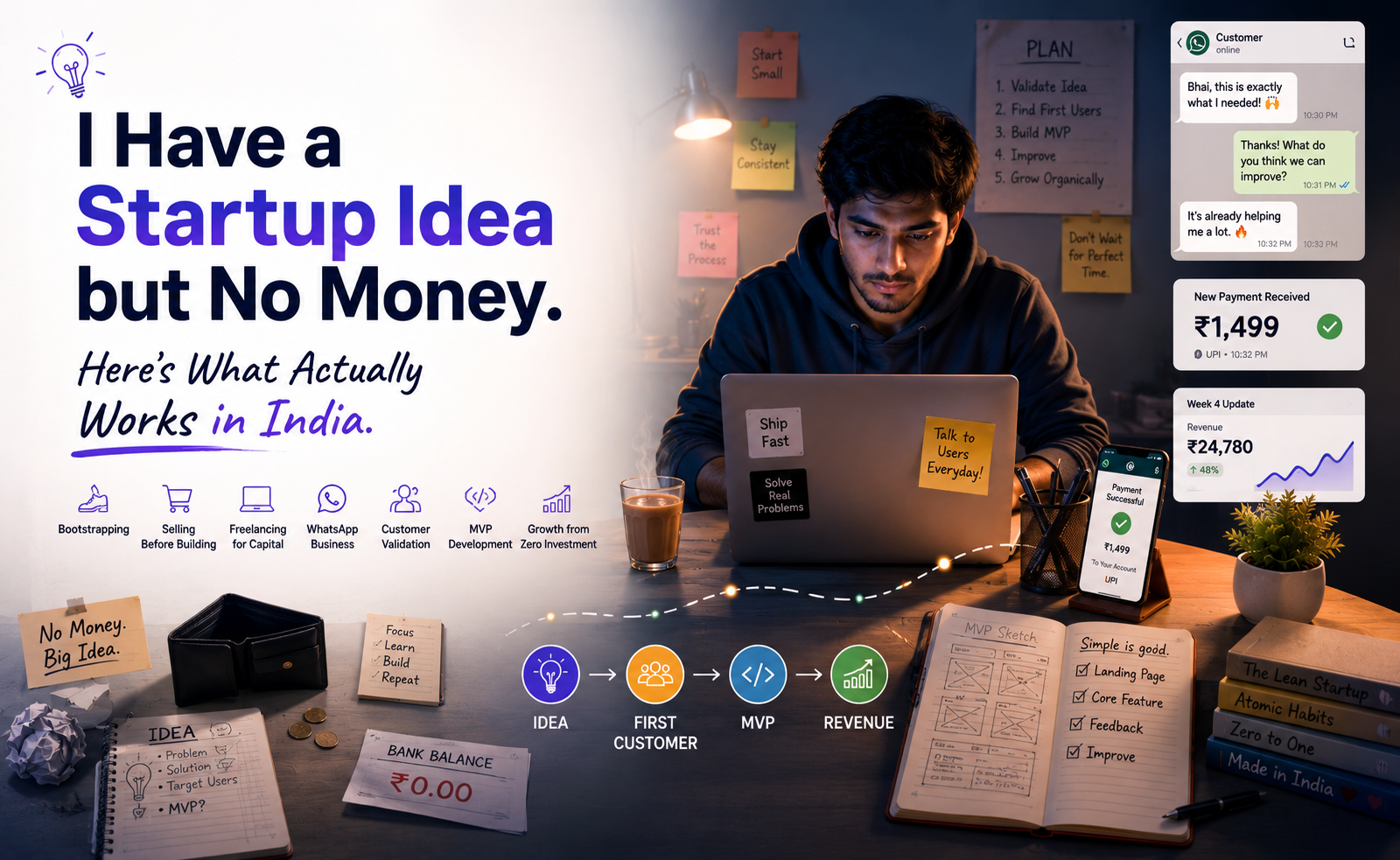
I Have a Startup Idea but No Money. Here's What Actually Works in India.
You don't need a funding round to start. Real paths Indian founders use to go from zero capital to a working business — bootstrapping, selling first, WhatsApp-era hacks, and programs built for broke idea-stage teams.
You have the idea. You've told three friends. Maybe you've even bought the domain. And then you open a spreadsheet, add up what it would cost to hire a developer, build an app, run ads, and incorporate a company — and the number makes your stomach drop.
So you wait. You tell yourself you'll start after you save ₹2 lakhs, or after you find a co-founder who codes, or after an investor says yes. Months pass. The idea is still in your Notes app. Nothing has moved.
Here's the uncomfortable truth most startup content won't tell you: lack of money is the default starting position for Indian founders — not an exception. The ones who build anyway aren't richer than you. They just chose a different sequence.
This post is about what actually works when you're idea-rich and cash-poor in India — not Silicon Valley fantasy, not "just raise a pre-seed," but real paths that founders here have used to get from zero to something real.
First, Kill the "I Need Funding First" Reflex
Somewhere along the way, startup culture taught us a backwards equation: idea → pitch deck → funding → build product → customers. That's one path. It's not the only path, and for most first-time founders in India, it's the slowest one.
Zerodha didn't raise venture capital for years. Zoho built from Chennai with almost no outside money. Freshworks started in a small office in Chennai when the founders couldn't afford premium tools. Meesho began by helping people sell on WhatsApp — not with a polished app and a war chest.
The pattern isn't "they had money, so they succeeded." It's "they found a way to create value before they had infrastructure." That's the skill worth learning.
What "No Money" Really Means (Be Honest With Yourself)
Before picking a path, get specific about what you're actually short on. "No money" can mean very different things:
- Zero cash — you literally can't spend ₹500 on a domain this month.
- No dev budget — you have some savings, but not ₹1–3 lakhs/month for a developer.
- No runway to quit — you're employed and can't go full-time for six months.
- No network — you don't know investors, mentors, or anyone who's built before.
Each constraint has a different answer. A college student with zero cash needs a different playbook than a working professional with ₹50k saved but no technical co-founder. Naming your actual constraint saves you from copying advice meant for someone else.
Path 1: Sell Before You Build
The oldest bootstrap trick in the book — and still the most underused in India — is to get paid for the problem before you build the product.
That doesn't mean scamming people. It means delivering the outcome manually first. If your idea is a platform connecting tutors with students, don't build the platform. Find five students who need help, find two tutors, introduce them, take a small commission, and do the scheduling over WhatsApp. If people pay you to solve the problem by hand, you've proven something a pitch deck never could.
Meesho's early story rhymes with this. Before it became a giant social-commerce platform, the insight was simple: millions of Indians wanted to earn by reselling, but didn't have inventory, logistics, or a storefront. The first version wasn't a slick app — it was helping resellers list products and share them on WhatsApp and Facebook. The technology came after the behaviour was proven.
What this costs: your time, a phone, and the willingness to do unglamorous work. What you learn: whether strangers will pay, what they actually care about, and what your product needs to automate first.
Path 2: Services First, Product Later
If you have a skill — design, writing, coding, marketing, accounting, video editing — you already have a funding source hiding in plain sight. Many successful Indian product companies started as agencies or consulting shops that funded the founder's living expenses while the product idea matured.
The logic is simple: services trade your time for cash immediately. Products take months before they pay back. Using services to fund your runway isn't a detour — it's how a huge number of bootstrapped founders survive the gap between "I have an idea" and "I have revenue."
Set a clear rule so you don't get trapped: the service work funds the product; it doesn't become the product. Block fixed hours per week for your startup. Invoice on time. Don't let client emergencies eat the only energy you had for building.
Path 3: Build With What India Already Gives You for Free
The cost of starting has never been lower — but only if you're ruthless about using free tiers and simple tools instead of dreaming about a custom-built app on day one.
A realistic zero-budget stack for many Indian founders right now:
- WhatsApp Business — customer support, orders, and community in a country that already lives on WhatsApp.
- Google Forms + Sheets — intake, tracking, basic CRM.
- Notion or Airtable — operations before you need real software.
- Canva — branding and social content without a designer.
- Razorpay Payment Links — accept money before you have a full checkout flow.
- No-code tools (Bubble, Glide, Framer) — only when manual work is genuinely breaking; not as procrastination.
Urban Company didn't start as a polished marketplace on day one. Neither did Swiggy. Early versions of big Indian startups were often held together with phone calls, spreadsheets, and operators doing things by hand. Your embarrassing v1 is in good company.
Path 4: Trade Time and Effort for Resources You Can't Buy
Money isn't the only currency. Founders with no capital often trade time, equity-free effort, or community contribution for things they'd otherwise pay for.
What this looks like in practice:
- Find a technical co-founder by starting as the business/market person on a real project — not by sending cold "I have an idea" messages.
- Join builder communities (local meetups, online cohorts, university incubators) where mentors and peers are accessible without a ₹50k program fee.
- Apply to residencies and hackathons that provide dev support, mentorship, or infrastructure instead of asking you for upfront cash.
- Barter — offer marketing, ops, or sales help to a developer in exchange for MVP work, with clear scope and deadlines.
The key is specificity. "Will someone build my app for free?" is a dead end. "I'll handle customer acquisition and operations; I need a WhatsApp-integrated booking flow built in three weeks" is a conversation.
Path 5: Programs Built for Founders With Ideas, Not Capital
A newer lane in India's ecosystem is programs designed specifically for the chicken-and-egg trap: you need a product to raise money, but you need money to build a product.
Accelerators like Y Combinator and Antler are powerful — but most take meaningful equity, and many expect you to already have traction or a technical team. If you're pre-revenue with a notebook full of ideas and no developer, that's a mismatch, not a moral failing.
What to look for instead:
- Zero or low upfront fees — if you have no money, a ₹30k application fee is a filter, not a feature.
- Hands-on build support — not just mentorship slides; actual developers, designers, or structured sprint time.
- No equity grab — or at minimum, terms you can live with if the company succeeds.
- Revenue-aligned repayment — models where you pay only after you earn, so downside risk stays low.
This is exactly the gap programs like TSIH India are built for: a 30-day founder residency where selected startups get a dedicated developer, mentors, accommodation, and infrastructure — with 0% equity and a royalty model that only kicks in after revenue. It's not the right fit for every idea, but if your blocker is "I can't afford to build," it's worth knowing these options exist in India now — not just in San Francisco.
What Doesn't Work (Even If It Feels Productive)
Saving yourself six months means being honest about what looks like progress but isn't:
- Writing a 40-page business plan before talking to a single customer. Investors and customers respond to proof, not prose.
- Waiting for the perfect co-founder while months pass. Start manually; co-founders join momentum, not static ideas.
- Building in secret for a year because you're embarrassed to show something unfinished. You'll learn more from one week of public scrappiness than a year of private perfectionism.
- Chasing grants and pitch competitions as a full-time job. Apply selectively; don't let applications replace building.
- Assuming you need a full app when a payment link and a WhatsApp group would test the same assumption.
Money problems are real. But a surprising amount of "I can't start" is actually "I won't start until the version in my head exists" — and that version is always too expensive.
A Simple Decision Framework
If you're sitting with an idea and an empty bank account tonight, run this:
- Can you deliver the outcome manually this week? If yes, start there. Charge something, even ₹100.
- Do you have a sellable skill? If yes, allocate 20% of your week to the idea and use services to fund the rest.
- Is the blocker technical? If yes, explore no-code, a scoped barter, or a zero-equity residency — not twelve more months of waiting.
- Are you avoiding customers? If yes, that's the real problem — not the lack of funding.
Write your answers down. Pick one path for the next 14 days. Not all five. Founders with no money can't afford to split focus.
The Real Advantage of Starting Broke
It doesn't feel like an advantage when you're checking your balance before ordering dinner. But constraints force clarity. When you can't throw money at problems, you learn which problems actually matter. When you can't hire, you learn what customers truly value. When you can't build everything, you ship the one thing that moves the needle.
India's best bootstrapped companies weren't built by people who had more money than you. They were built by people who stopped waiting for permission and started with the tools, time, and relationships already in front of them.
You have a startup idea and no money. That's not a disqualification. It's the starting line most founders share. The only question left is which path you'll walk first — and whether you'll start this week, or after one more month of planning you can't afford.