
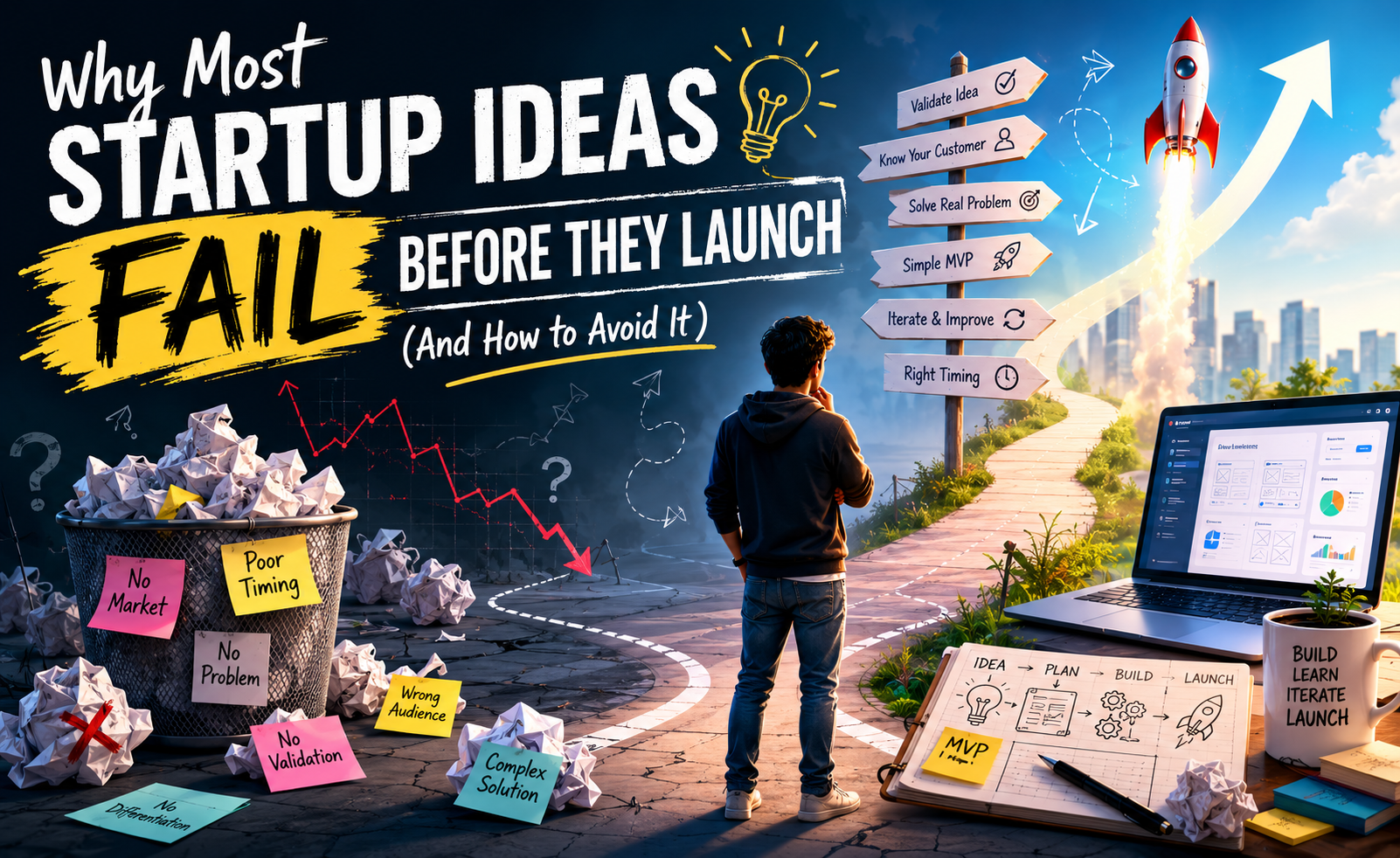
Why Most Startup Ideas Fail Before They Launch (And How to Avoid It)
Real stories and real numbers on why 9 out of 10 startups fail — from Juicero and Quibi to PepperTap and TinyOwl — and what founders can do differently starting today.
Real stories. Real numbers. Written simply so you can actually use it.
Let's start with a number that stings a little.
9 out of 10 startups fail.
Not struggle. Not go through a rough patch. Fully shut down. CB Insights studied 431 startups that closed since 2023 and found that 43% of them failed not because they ran out of money — but because nobody actually wanted what they built.
Almost half. And the part that really hurts? Most of those founders had the warning signs right in front of them before they ever launched. The market wasn't hiding anything. The customers weren't lying. Founders just weren't asking the right questions early enough.
So this is about that — why startup ideas die, with real companies and real numbers from both India and abroad, and what you can actually do about it.
Reason #1: The Problem Isn't Painful Enough
There's a big difference between a problem that's a little annoying and one that genuinely hurts people badly enough to pay for a fix. Startups die all the time because founders confuse the two.
Think about it simply. If someone asks you "does your back ever hurt after a long day?" — you'll probably say yes. But would you pay ₹5,000 for a special cushion? Probably not. It wasn't hurting badly enough.
That's exactly what happened with Juicero.
In 2013, Doug Evans founded a company in San Francisco built around a Wi-Fi connected kitchen machine that pressed fresh juice from special packs — just push a button, get juice. No mess. No effort. Investors including Google Ventures and Kleiner Perkins poured in over $120 million. The machine launched at $699 (roughly ₹58,000).
Then in April 2017, Bloomberg published a video showing that those special juice packs could be squeezed just as effectively by hand. No machine needed.
The internet went crazy. Memes everywhere. Juicero shut down in September 2017, just 18 months after launching, having burned through nearly all of that $120 million.
But here's what's important — the Bloomberg video didn't kill Juicero. It just revealed the real problem, which was there from day one. People were already solving the "juice at home" problem just fine — buying it from a store, making it themselves, or as it turned out, squeezing a pouch with their hands. There was no real pain that needed fixing.
"The number one reason startups fail is they have a solution without a problem."
What to do instead: Before building anything, ask yourself honestly — how much does this problem actually cost someone, in time, money, or stress? If the answer is "it's mildly inconvenient sometimes," you don't have a startup. The problem needs to be something people are actively and repeatedly failing to solve, and are already spending energy trying to fix with whatever imperfect options exist.
Reason #2: They Never Talk to Real Customers
Most founders start with a problem they personally faced. That's actually a great starting point. The mistake is when they stop there.
They assume that because the problem exists for them, it exists the same way for everyone else. They design the product around what they imagine people want. And they skip the part where they go out and actually verify it with real people.
Quibi is the most expensive example of this mistake in recent memory.
Launched in April 2020 by Hollywood veteran Jeffrey Katzenberg and former HP CEO Meg Whitman, Quibi was a mobile streaming app delivering 5 to 15 minute videos — built for people to watch during commutes, waiting rooms, and lunch breaks. It raised $1.75 billion before a single user ever touched it.
The entire idea rested on one assumption — that busy commuters wanted bite-sized premium content and would pay a monthly subscription for it. Nobody tested that assumption with real people first.
When it launched, three things went wrong immediately. First, it launched during COVID lockdowns — their entire target audience was at home, and nobody was commuting. Second, you couldn't screenshot or share anything from the app, which killed any word-of-mouth in the age of TikTok and Reels. Third, none of the content became genuinely must-watch. As one media analyst said bluntly: "If there was content people couldn't live without, they would have subscribed. The numbers speak for themselves."
Quibi shut down six months after launching. The co-founders themselves admitted that "product market fit was wrong." They spent nearly two billion dollars finding that out — when honest conversations with 30 real commuters could have shown most of this before a single dollar was raised.
What to do instead: Before building your product, have 10 to 15 real conversations with people who could be your customers — not your friends, actual strangers. Don't pitch your idea. Just ask about their daily life, their frustrations, and the problem you think you're solving. If five different people describe the same frustration in the same words, that's a signal. If they shrug and move on, you've just saved yourself months of wasted effort.
Reason #3: They Grow Before the Business Actually Works
There's a seductive trap in the startup world — if you can just get enough users, the business model will figure itself out later. Scale fixes everything.
It doesn't. Scale amplifies everything — including the cracks underneath.
Homejoy is the clearest example of this. Founded in 2010 by siblings Adora and Aaron Cheung and backed by Y Combinator, Homejoy raised $40 million to build an on-demand home cleaning marketplace. At its peak, it operated in 30+ cities including New York, London, and Berlin. Paul Graham called it the fastest-growing company to come through Y Combinator.
From the outside it looked like a rocket ship. Inside, the economics were broken from day one.
To get new customers, they offered first-time cleanings for just $19, when a standard cleaning cost $85 or more. A study later found that only 25% of customers used the service again after the first month, and fewer than 10% became regular users. They were losing money to acquire people who never came back.
On top of that, since cleaners were classified as independent contractors, Homejoy couldn't train them — so quality was inconsistent. Trust, which matters enormously when strangers enter your home, was never reliably built. Legal troubles followed. Homejoy shut down on July 31, 2015.
The idea wasn't bad. They just scaled it across 30 cities before it worked in even one.
What to do instead: Before thinking about growing, ask one honest question — if I removed all discounts and promotions tomorrow, would people still come back? If no, you haven't built a real business yet. Fix the core experience first. Make sure your first location truly works — with returning customers, word-of-mouth referrals, and healthy margins — before you replicate it anywhere else.
Reason #4: The Timing Is Just Wrong
One more thing the data shows — 29% of startups fail because of bad timing, not a bad idea.
Quibi's timing was off in multiple ways. Short-form mobile video was clearly a big market — TikTok proved that. But Quibi's version was behind a subscription paywall and couldn't be shared. The world had already decided short video should be free and viral. Quibi bet against that direction, and it was too late to change course.
Compare that with Zoom — which had existed quietly since 2013 while most people ignored it in favour of Skype and Google Hangouts. Then March 2020 happened, remote work became a necessity overnight, and Zoom became a verb. Same product. The timing finally matched the world.
Passion for an idea doesn't change whether the market is ready for it yet.
What to do instead: Ask three simple questions before committing — Is this problem getting worse for people right now? Has something changed recently in technology, habits, or culture that makes this solution possible today when it wasn't before? Are early adopters already cobbling together messy workarounds? If yes to all three, the timing is right. If nothing has changed recently to make your idea timely, you might be too early.
Closer to Home: Three Indian Startups That Teach the Same Lessons
India is now the third-largest startup ecosystem in the world with over 1.28 lakh registered startups. But over 5,000 of them shut down in 2024 alone. The reasons? Almost identical to everything above — just with different cities and familiar names.
🛒 PepperTap — Grocery Delivery (Gurugram, 2014)
Two IIM graduates built an app to order groceries from nearby local stores and get them delivered to your door. They raised $51.2 million from Sequoia Capital, SAIF Partners, and Snapdeal. Within a year — 25 cities, 20,000 daily orders, 2,500 employees.
But every single order was losing money. They didn't own any inventory, sourcing from local stores at MRP and selling below MRP on discounts to attract users. When they tested pulling back the offers, customers left immediately. The loyalty was to the deal, not to PepperTap.
PepperTap shut down in April 2016. Over ₹350 crore in funding, gone.
The lesson: Customers who come only for a discount aren't really your customers.
🍔 TinyOwl — Food Delivery (Mumbai, 2014)
Five IIT Bombay graduates built a food ordering app where you could even see the chef's profile while your food was being made. They raised around ₹200 crore and were growing four times faster than Swiggy in their early days.
Then they expanded too fast across 11 cities, building a fleet of 1,000 delivery staff in areas where the actual order volume didn't justify it. Co-founder Saurabh Goyal later admitted in an Economic Times interview: "We had 1,000 delivery boys, but the kind of scale we had there, 1,000 delivery boys were not needed. That's where all the unit economics took a hit." They were burning ₹8–10 crore every month.
Swiggy and Zomato caught up fast. Funding dried up. TinyOwl shut down in May 2016, with users receiving a notification that services were being discontinued in their city.
The lesson: Hiring 1,000 people before you need them doesn't make you look big — it just makes you sink faster.
🏠 Stayzilla — Travel & Homestays (Chennai, 2005)
Often called the "Airbnb of India," Stayzilla let travellers book homestays, guesthouses, and budget hotels across India — including small towns and Tier-2 cities nobody else was covering. They raised $34 million, listed 55,000 properties across 900 cities, and had a genuinely good idea.
But to compete with MakeMyTrip and Goibibo, they started giving 30–50% discounts on bookings — on margins that were only 10–15% to begin with. They were paying out of their own pocket on every booking. The founder later admitted he had stopped tracking cash flow and was instead chasing vanity numbers like room-nights booked and total listings.
With five months of runway left and no new investors, Stayzilla shut down in February 2017 — followed by a public controversy when the founder was briefly arrested over unpaid vendor dues, sparking the hashtag #FreeYogiNow across Indian startup Twitter.
The lesson: Big numbers that don't connect to actual revenue are a trap. Always track the one thing that matters: are we making more money than we're spending?
The One Pattern That Runs Through All of It
Whether it's a Silicon Valley company burning $1.75 billion or a Mumbai food app built by IIT graduates — the failure almost always traces back to the same thing.
They built something. Then found out too late that nobody wanted it badly enough to pay full price, come back, or tell a friend.
Not because founders weren't smart — PepperTap was IIM alumni, TinyOwl was IIT alumni, Stayzilla ran for 12 years. These were genuinely capable, hardworking people. They just built before they truly understood the market, grew before the basics worked, and chased users with discounts instead of earning them with real value.
Three Things You Can Do Differently — Starting Today
- Talk before you build. Have 10 real conversations with potential customers. Ask about their life and frustrations — don't pitch your idea. If they never bring up the problem on their own, think hard about whether it's painful enough to build a business around.
- Test the scrappiest version first. A WhatsApp group. A Google Form. A manual service you run by hand. If people don't engage with the rough version, they won't use the polished one either.
- Earn loyalty before you chase growth. 100 users who come back every week are worth far more than 10,000 who signed up for a discount and disappeared. Real retention is the clearest signal that something is working.
The startup graveyard — from San Francisco to Mumbai to Chennai — is full of talented people who fell in love with their idea before truly understanding their customer's problem.
The ones who made it did it the other way around. Customer first. Idea second. Build last.
Start there.
Found this useful? Share it with someone who's building something — it might save them months of wasted effort and a lot of heartbreak.